
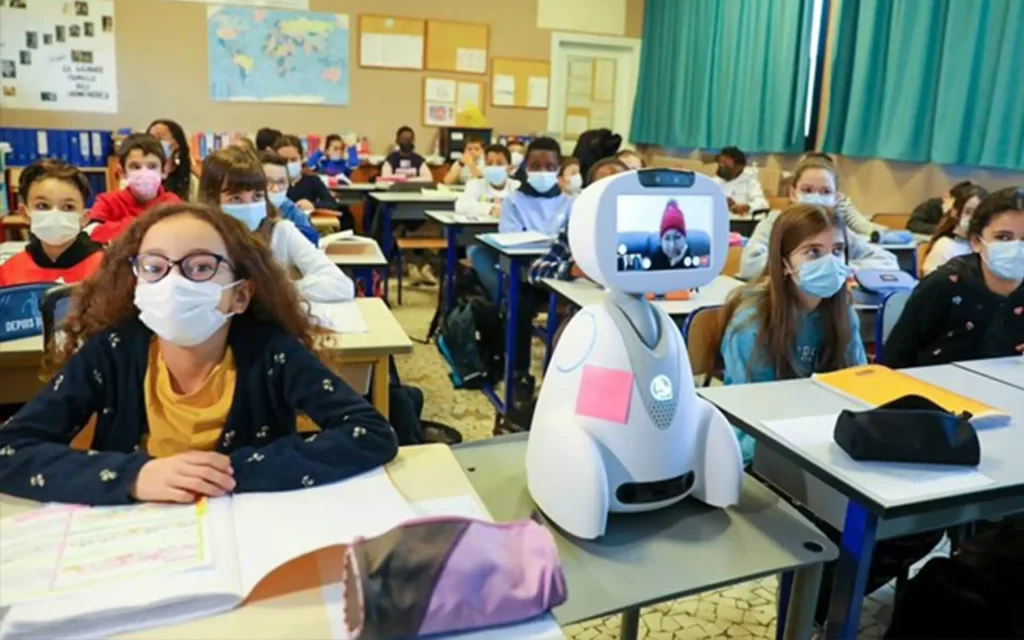
Buddy robot for inclusion & The Ministry of National Education
The TED-I program allows children to continue their schooling, even while hospitalized, and maintain connections with their classmates. Today, this is possible thanks to Buddy, the robot for inclusion and the avatar for sick children.
Never without my class: 1750 Buddy robots for inclusion in schools
From his hospital room, Buddy allows the student unable to attend school to interact with his class. Thanks to his ability to emit interactive signals (moods, messages, requests to speak, etc.), he can also move around the classroom and follow his classmates during recess, in the cafeteria, or on school trips.
Buddy is more than just a remote learning device for the sick child. This small, wheeled robot with its big, cute eyes fosters connection through its role as an emotional companion. He helps the child be accepted as a true classmate. Indeed, Buddy’s empathetic nature makes him a more compelling presence than a traditional video conferencing solution. He allows for a stronger physical connection with the student. Given that socialization improves children’s chances of recovery, Buddy becomes a true superhero. Integration is not only educational but also social.
Primarily intended for primary school students aged 5 to 11, Buddy robots allow remote students to be “tele-present”.
“Not only do they participate in all teaching activities, but they can also interact with their environment. Telepresence robots allow them to move around, exchange information, and register their presence within the institutions, which they continue to occupy “physically.””
Jean-Michel Blanquer, former Minister of National Education
TED-i: A school inclusion project unique in the world with buddy

The Ministry of National Education has launched the national TED-i program, providing an initial allocation of 4,000 robotic telepresence systems. These devices are intended for children and young people, from preschool to university, who are unable to attend school due to illness, hospitalization, or chronic home care.
Each year, nearly 12,000 students are hospitalized for extended periods. For these students, the continuity of their education must be ensured, regardless of their situation, if their hospitalization conditions allow.
A Home-Based Educational Support Program (APADHE) is being implemented to maintain educational continuity. In addition, and to ensure social continuity—namely, maintaining human contact with teachers and classmates—the Ministry of National Education is providing telepresence robots to educational institutions from the beginning of primary school through university for young children. This also applies to young adolescents and adults with serious, long-term illnesses, allowing them to continue learning while preserving their connection with their original school or institution.
TED-i aims to mitigate the consequences of the disruption to the school or training environment for isolated young people and to facilitate their return to the classroom, both for learning and for the continuation of genuine inclusion and socialization.
« We’re maintaining a school connection, almost an emotional one, with classmates.
And this will help the student throughout their illness. The effects are tangible. As soon as the parents see this, it also gives them a little hope.»
Christophe CARON – Director of TED-i Project
TESTIMONIALS from the TED-i project robots for inclusion
“It’s not complicated and it’s fun… It’s more convenient than if someone else brought me the lessons. It’s better. And most importantly, I can still see my friends.”
Gabriel, a student in CE1 (second grade)
“This Buddy robot is a wonderful solution, a tool that puts children on equal footing. The best of technology is put at the service of the individual. The child feels the classroom. He experiences the classroom.”
Henri PrévotPrefect of Marne
“When I’m with Buddy, I feel good, I feel like I’m in class even though I miss playing games and going to the cafeteria with my friends.”
Melvin, a student in CE2 (second grade)
“We were impressed when we discovered the device; Naël immediately took to Buddy with great ease. Buddy allows Naël to keep up with schoolwork without falling behind and it lets him stay in touch with his friends. Buddy allows Naël to see his friends every day and chat with them.”
Naël’s mother
“The process is simple: Naël connects to Buddy using the control tablet. This allows him to be immersed in the classroom, follow the lessons, and even participate! He easily controls the robot remotely and is therefore seamlessly integrated into classroom life. For Naël’s parents, the Buddy robot is reassuring because there is no disruption to his learning.”
Michelle NAKIELNY, Naël’s first-grade teacher
“What a privilege to be able to make an absent student present!! Everyone experiences this situation as a given, a technological advancement at the service of humanity.”
The digital education team of the Nancy-Metz Academy