
“Robotics Workshop for High School Students: Between Art, Emotion, and an Introduction to Coding with Buddy
This is the central question of a study conducted with 161 participants high school students, future teachers, and university students which shows how Buddy profoundly transforms teaching practices, from emotional expression to an introduction to coding, during a robotics workshop for high school students.
A widespread adoption, with results that speak for themselves
The exercice measured the impact of Buddy robot across several pedagogical and interaction criteria. Data collected from observations and questionnaires paints an encouraging picture: Buddy robot generates strong engagement and a largely positive perception across all profiles. Those statistics presented below clearly reflect the success observed during the high school robotics workshop.
[Podcast IA-ÉDU 2025] Repenser les pratiques d’enseignement et d’apprentissage par la robotique éducative : le cas du robot socio-émotionnel Buddy | Par Ismail Badache et Elisabeth Colombo
93%
Highly engaged learners during sessions with Buddy.
92%
Appreciate the robot’s expressive face and humanoid posture.
88%
Considering Buddy useful for language learning.
86%
Recommend integrating robotics into teaching practices.
79%
Identify a concrete contribution to learning coding.
71%
Find Buddy easy to use from the very first interaction.
“A 93% engagement rate demonstrates the positive impact of the tool in terms of motivation and interaction. The use of robots in classrooms appears to play a crucial role in stimulating attention and participation.“

Badache & Colombo
IA-ÉDU@CORIA-TALN 2025
A study grounded in real-world practice: a robotics workshop for high school students
One of the strengths of this research lies in the diversity of its sample: high school students in a school setting, trainee teachers at the INSPE of Aix-Marseille University, and students from other university programs. This variety enables a comparative analysis of the robot’s uses and perceptions according to educational level and learning context.
- 79 High School Students
- 59 Students from INSPE of Aix-Marseille University
- 23 Other University Students
Plural approach ensures the robustness of the findings. Whether it is a high school student discovering robotics for the first time or a future teacher imagining teaching scenarios, se was able to adapt to very different profiles while maintaining a remarkably high level of engagement.
From art to the classroom: two ways of learning with Buddy
This study is structured around two complementary experiments, each exploring a distinct aspect of Buddy’s educational potential. At first immerses participants in the world of artistic and emotional education. The second integrates Buddy into an academic curriculum designed for future teachers. Together, they outline the contours of an educational robotics approach that is embodied, empathetic, and critical.
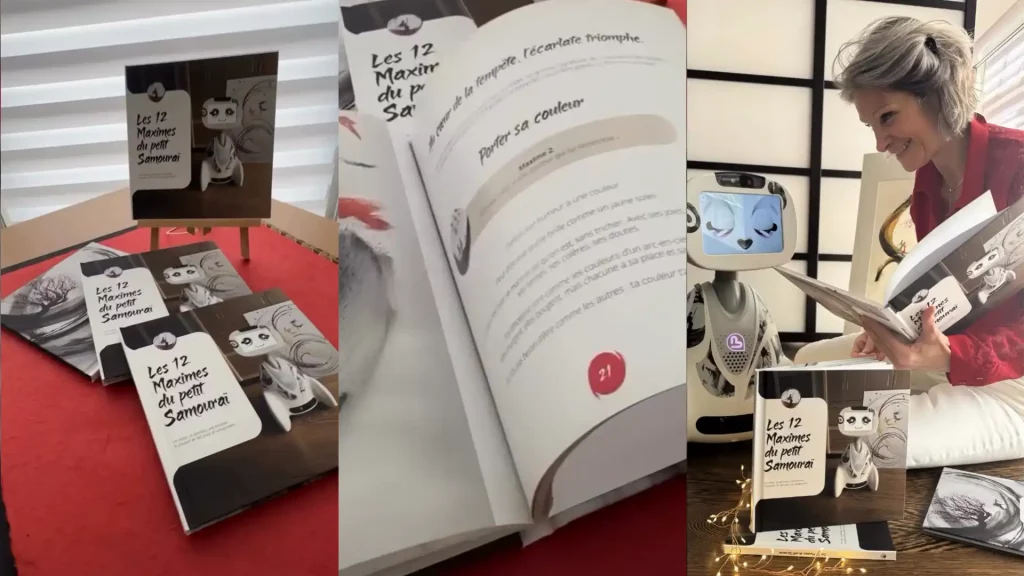
Artistic and Emotional Education
In workshops designed for children aged 7 to 10, as well as for audiences who are inhibited or in emotionally vulnerable situations, he was used as an artistic mediator.
Two scenarios were developed:
- Shared emotion, where the robot interprets visual artworks and invites participants to express their own feelings, and Buddy’s Whispers.
- An illustrated narrative centered on a figure of resilience, the Scarlet Warrior, exploring themes of loneliness, doubt, and hope through poetic storytelling. In this context, the robot acts as a benevolent mirror, receiving each creation without judgment.
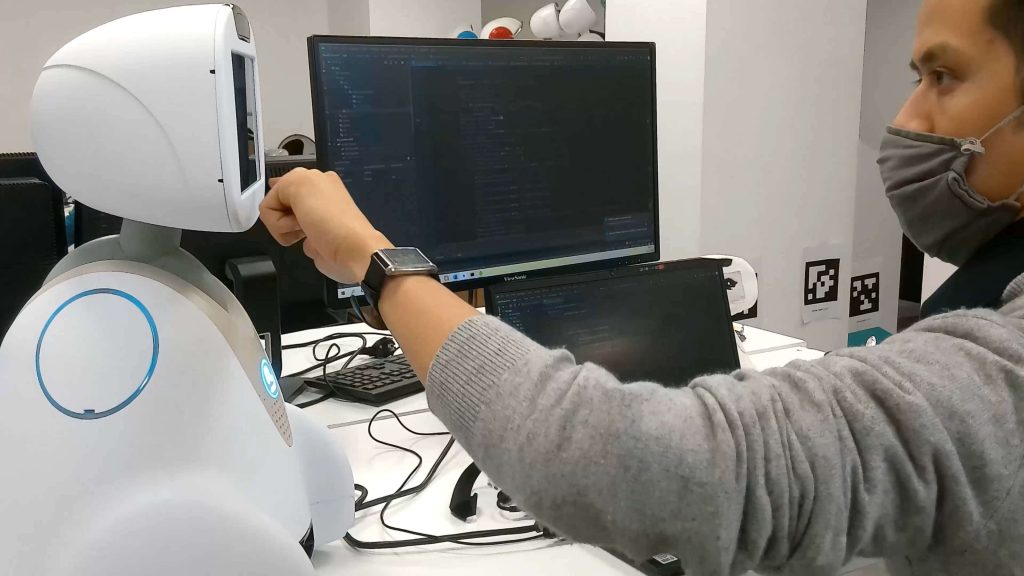
Teacher Training at INSPE
At the Institut National Supérieur du Professorat et de l’Éducation (INSPE) of Aix-Marseille University, he was integrated into training programs designed for future primary and secondary school teachers, as well as instructional designers.
The objective was to explore how educational robotics can enrich the design of learning resources, introduce young learners to coding, and act as an intelligent assistant through an LLM (large language model).
Even Buddy’s technical imperfections were used pedagogically to demystify AI and develop learners’ critical thinking about the biases and limitations of automated systems.
a companion with multiple roles
The surveys highlighted four major areas of use that position Buddy far beyond a simple technological tool. It alternates between being a discovery companion, an interactive assistant, an emotional mediator, and a revealer of AI’s limitations. Here is how these roles were enacted in practice during the high school robotics workshop.
- Technological awareness and resource design: by interacting with Buddy, future teachers were able to envision concrete applications of robotics in teaching science, coding, and algorithmic logic.
- Introducing young children to coding: thanks to its cartoon-inspired appearance and accessible robotic voice, he allows younger learners to approach programming without intimidation.
- Intelligent assistant and natural conversation: integrating an LLM, Buddy acted as an interactive assistant, responding to students’ questions in a contextual and personalized way.
- Demystifying AI and developing critical thinking: Buddy’s technical shortcomings limitations in contextual understanding and the repetitiveness of some responses were used as full-fledged teaching tools.
this emotional robot goes beyond a functional tool to become a true catalyst for interaction.
“By stimulating introspection, creativity, and social connection, Buddy reveals by contrast the complexity and richness of human dynamics. Its potential lies less in simulating emotions than in its ability to bring out what we truly feel.”
Badache & Colombo
IA-ÉDU@CORIA-TALN 2025
Buddy and Educational Inclusion
Explorations also highlights Buddy’s potential in broader inclusive education contexts: communication with multilingual learners, support for students in hospital or outside the traditional school system, and assistance for students with disabilities. While institutional commitment is necessary to scale these uses, Buddy’s relatively affordable cost makes it a credible option for schools seeking to invest in technology that serves all learners.

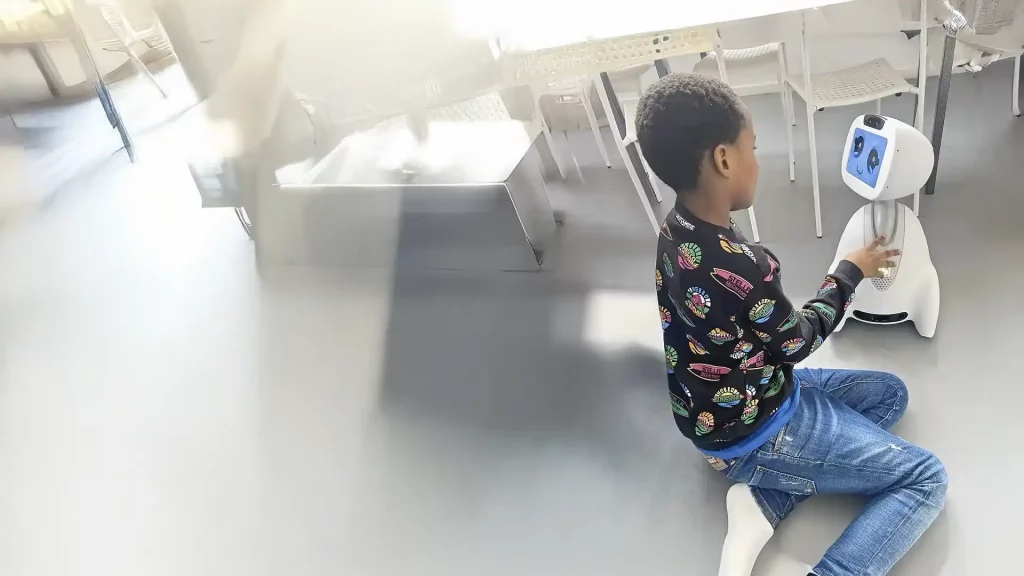
Discover Buddy, to stay connected and safe every day.
The first AI emotional robot can promote emotional well-being and offer new enriching activities at home, in workshops, or during group sessions.
students and teachers
Buddy is an interactive educational tool that engages students, supports learning, and helps teachers in their innovative teaching practices.
children with neurodevelopmental disorders
Through its playful, guided interaction, Buddy helps stimulate attention, learning, and social skills in children with autism or other neurodevelopmental disorders.
older adults experiencing loss of independence
Supporting daily routines, strengthens social connection, and promotes the well-being of older adults in care facilities and at home.
Buddy, Your Ambassador
Unique brand ambassador that welcomes, guides, and informs visitors while offering interactive experiences.
Through these key areas, Buddy transforms technology into a practical tool for building connections, encouraging interaction, and supporting everyday life in a human way.
Buy BUDDY !
Interested in acquiring Buddy? Don’t hesitate fill out our quote request form by clicking the link below