
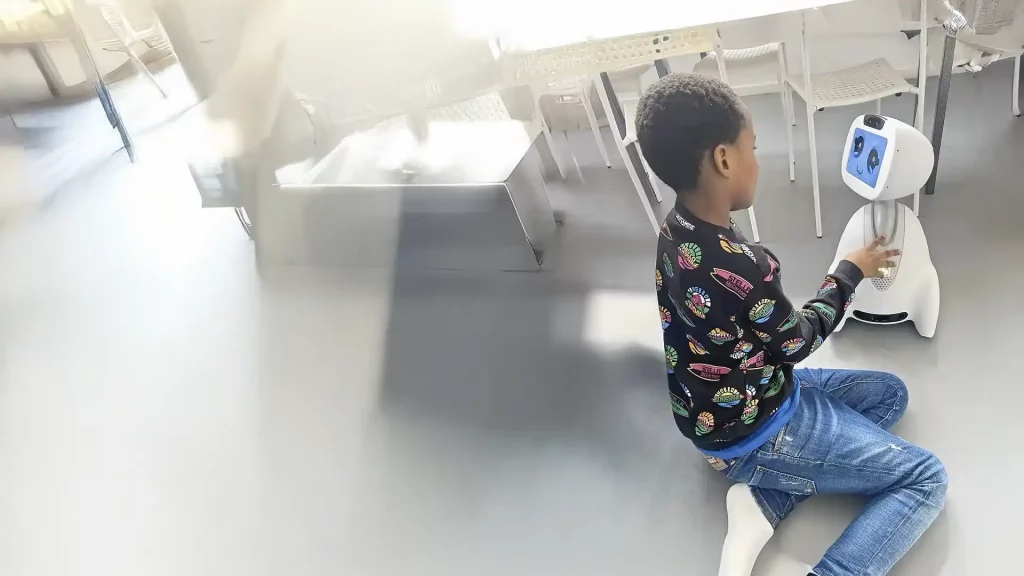
robot for children with autism: Buddy, an innovation tested at the Le Phare IME (Medico-Educational Institute)
New technologies are gradually transforming the support provided for individuals with autism spectrum disorders (ASD). Among them, the robot therapy for autism is emerging as an innovative tool for professionals and children.
The Buddy robot, developed by Blue Frog Robotics, is currently being tested in several healthcare and social service facilities, including the Le Phare Medical-Educational Institute (IME) in France. Initial results are promising, particularly in terms of communication, social interaction, and emotional development.
their needs
+ Support educators
+ Improve communication
+ Work on emotional regulation
+ Develop social skills
+ Improve psychomotor skills
Buddy: as a robot for children with autism focused on social interaction
Buddy is an emotional robot designed to support people with neurodevelopmental disorders, including autism.
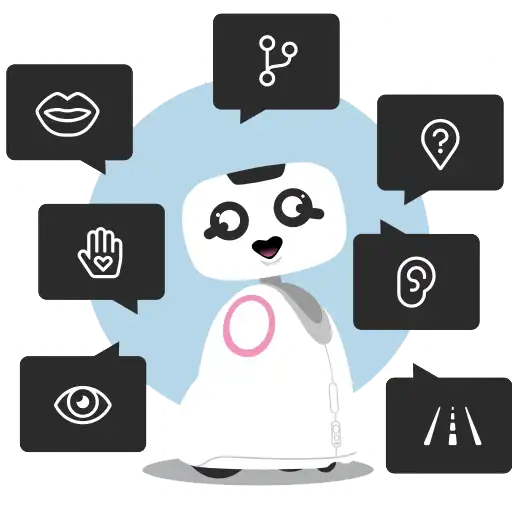
Equipped with emotional artificial intelligence, it is capable of:
- Interacting with voice and touch
- Moving independently
- Expressing emotions
- Offering educational and therapeutic activities
Unlike traditional digital tools, Buddy is an “embodied” robot, which promotes a more natural and stronger engagement among children.
This makes buddy a robot for children with autism particularly suited to the specific needs of children with ASD.
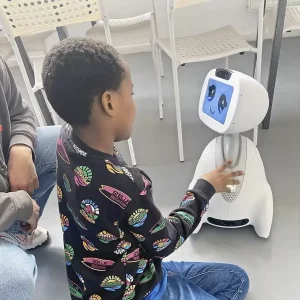
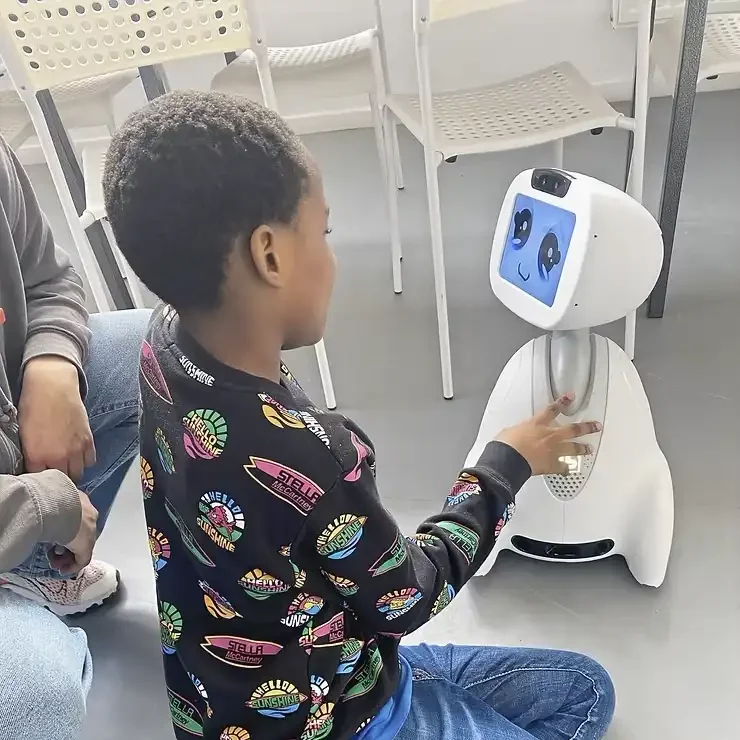
Experimentation at the IME Le Phare: a concrete case of use
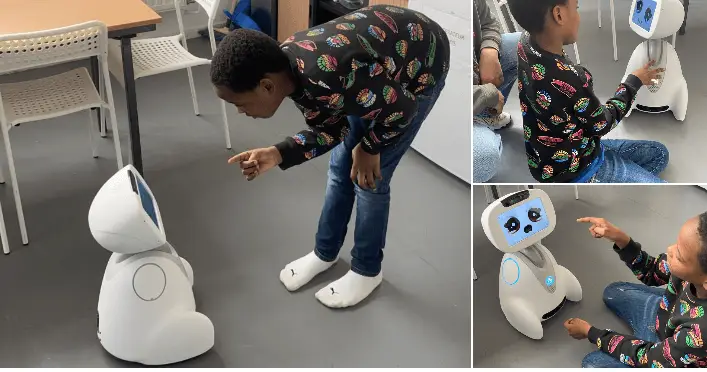
At the Le Phare Institute for Medico-Educational Care (IME), located in Neuilly-sur-Seine, Buddy has been used for several months to support young people with autism.
Professionals use it in particular for:
- Working with emotions
- Developing social skills
- Improving psychomotor skills
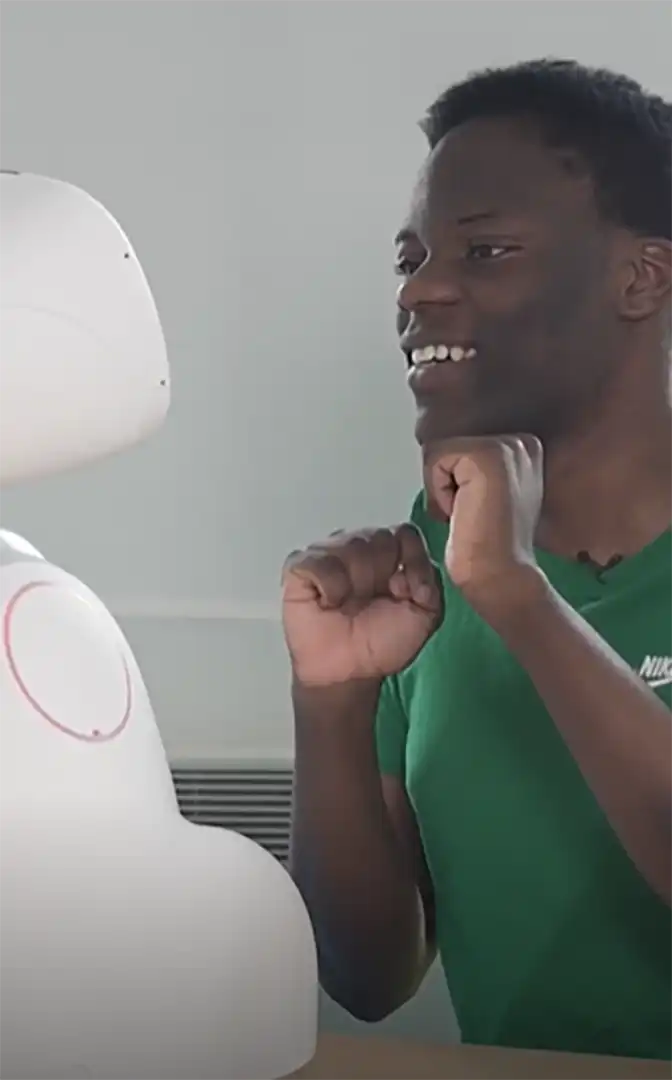
The feedback is very encouraging: the children interact spontaneously with the robot and show genuine interest in the activities offered.
For example, some children engage in conversations with Buddy about their interests, which represents a significant step forward in their communication skills.
Why does Buddy work with autistic children?
Buddy’s effectiveness as a robot for children with autism is based on several key features.
A simple and predictable interaction
Children with autism are often more comfortable with structured and repetitive interactions.
Robots, like Buddy:
- offer predictable responses
- avoid complex expressions
- reduce sensory overload
This facilitates engagement and decreases anxiety.
A tool for learning about emotions
Buddy offers specific applications that allow you to:
- identify emotions
- reproduce them
- understand them in a social context
These exercises are essential for the development of social skills in children with ASD.
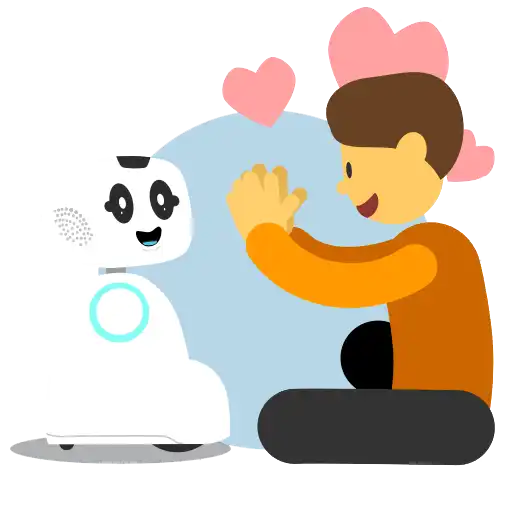
A relationship of trust made easier
Children with autism often develop a faster relationship with robots than with humans.
Why?
- Lack of judgment
- Consistent behavior
- Playful interaction
Buddy thus becomes a mediator between the child and his social environment.
TECHNICAL SOLUTIONS & SOFTWARE
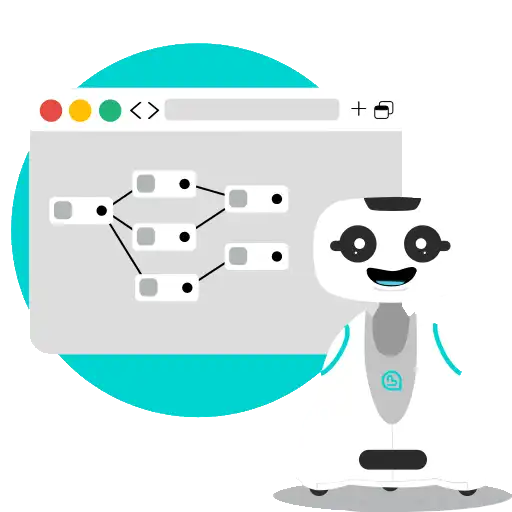
To best meet the specific needs of our clients, we have designed and developed a suite of applications and dedicated content to enrich the user experience with the Buddy robot. Each solution has been tailored to its intended use, whether educational, recreational, informative, or interactive, to ensure seamless and relevant integration into various usage contexts.
Some activities, such as interactive musical games and emotional recognition exercises, are particularly popular with children.

COMPAGNON
Application

Buddy PLAYER
Application

Buddy STUDIO
Web Application

Buddy emoi
Application

Carte blanchE
Application

jeu de gestes
Application

scénarios
Contenu
The benefits of robots therapy for autism
The use of Buddy in structures like the IME Le Phare highlights several advantages:
Improved social interactions
Children communicate more and initiate exchanges more easily.
Anxiety reduction
The robot’s predictability reassures children.
Boosting motivation
The playful nature of the activity encourages participation.
Complement to traditional therapeutic approaches
Buddy does not replace professionals, but enriches support methods.
Customer feedback and experiences
The results observed in the field confirm the potential of these technologies in the healthcare and social services sector. Here are some excerpts from user feedback we were able to gather from children and professionals.
“He’s kind of like a friend to me! … There are definitely some things I’ve learned about emotions thanks to Buddy.”

Kid
Patient – IME Le Phare
“Timothée is used to speaking very, very fast, and with the robot, he manages to regulate himself and speak more slowly.”

Yves
Psychiatrist – Le Phare Special Education Institute
EN Conclusion
The Buddy robot perfectly illustrates the evolution of support practices for individuals with autism. As a robot for children with autism, buddy brings a new dimension to care by combining technology, interaction, and emotion.
Experiments conducted at the Le Phare Institute for Children with Disabilities show that these robots can play a key role in developing the social and emotional skills of autistic children.
In the future, these solutions could become essential tools for healthcare and special education professionals.
Discover our client projects
Find all our projects, and imagine new challenges to meet your needs!t imaginez de nouveaux défis pour répondre à vos besoins !
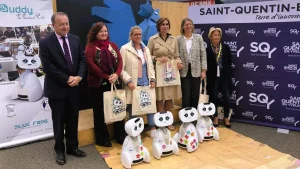
Success Story : SQYPi
Educational Robot for Inclusive Education: The SQYpi Project with Buddy How can artificial intelligence and social robotics help create a more inclusive learning environment? This is the vision behind the…
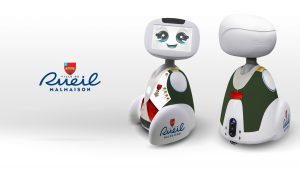
Success Story : Rueil-Malmaison
Smart City Robot: Buddy Supports Citizen Services in Rueil-Malmaison How can artificial intelligence improve the relationship between citizens and public services? The City of Rueil-Malmaison answered this question by deploying…

Success Story : Galerie Lafayette
Success Story Galerie lafayette : Retail Robot Buddy at Galeries Lafayette How can technology make shopping more engaging and memorable? To answer this question, Buddy was deployed as a retail…
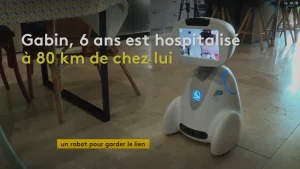
Success Story : Hope-Manon
HOPE MANON: Buddy, a robot for inclusion Children hospitalized for leukemia are placed in a sterile room for a period of 3 to 6 weeks. During this period of strict…