
Social Robots and Pedagogy: What Can We Learn from UNIT’s Experiment with Buddy?
How can generative AI make educational interactions more human? This is the question explored by UNIT through an experiment conducted with Buddy, a social robot focused on education, designed to promote natural exchanges between humans and conversational technologies.
Les besoins des écoles et universités face aux nouveaux usages pédagogiques
+ Digital transformation,
+ Student engagement,
+ New pedagogical interactions,
+ Enhanced human support,
+ Inclusion and accessibility.
Exploring New Educational Interactions Through Social Robot
How can social robots meaningfully support teaching and learning experiences in higher education?
This is the question explored by UNIT Fondation through an educational experiment conducted with Buddy, the social robot developed by Blue Frog Robotics.
Designed to encourage interaction and engagement, Buddy the social robot for education was tested in different contexts to better understand how social robotics could contribute to innovative pedagogical practices. Beyond the technological aspect, the objective was to evaluate the real educational value of social robots in workshops, demonstrations and student-centered activities.
The experiment highlighted both the opportunities and the current limitations of social robotics in education. While Buddy proved highly effective at capturing attention and encouraging participation, the experience also demonstrated that long-term educational value depends as much on pedagogy as on technology itself.

Why did UNIT choose Buddy?
- Identified needs
- Use cases
- Learning objectives
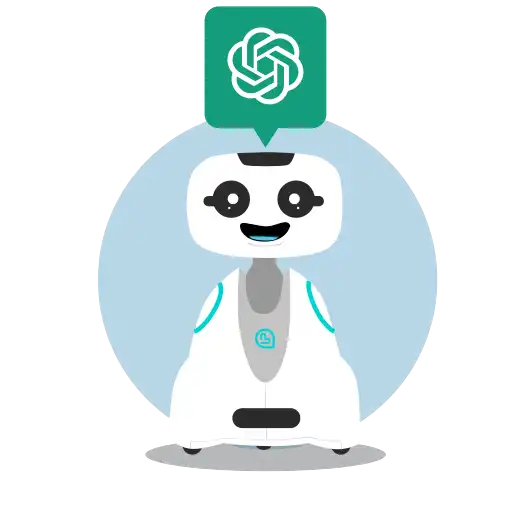
How generative AI was integrated
- Natural interactions
- Conversational understanding
- Personalization
- Contextual dialogue
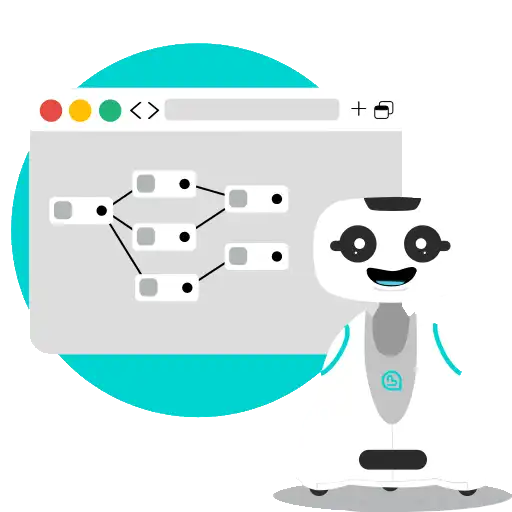
Observed usage scenarios
- Home
- Mediation
- Support
- Educational Demonstration
- Student Interactions
What We Observed During the Experiment
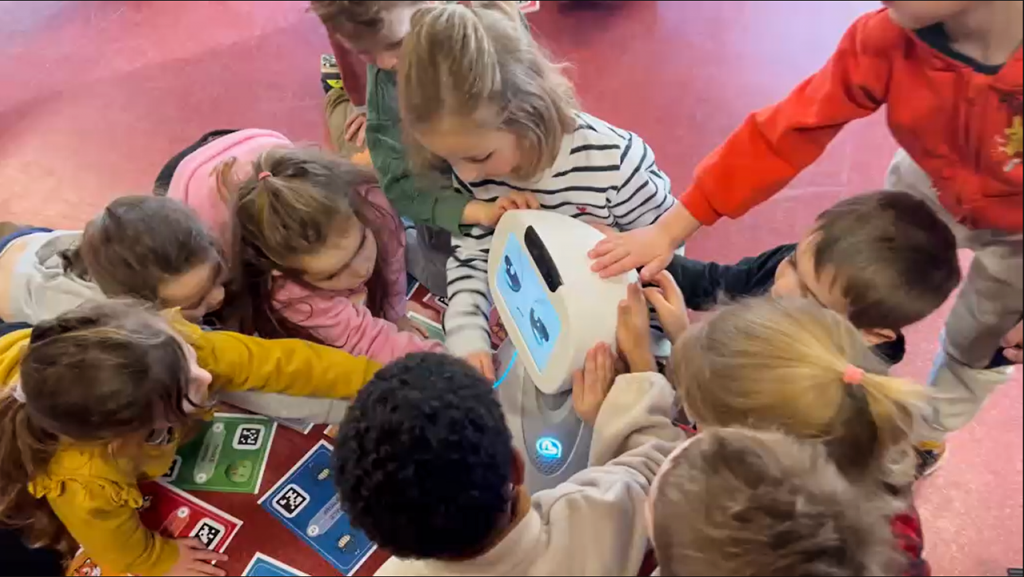
One of the first observations made during the project was Buddy’s ability to immediately attract attention and stimulate interaction.
The robot naturally encourages communication and participation, especially among more reserved audiences. Its physical presence and interactive capabilities helped create more engaging and dynamic educational activities.
Several positive outcomes were identified during the experiment:
- Easier participation and communication
- More interactive activities
- Stronger engagement, particularly among younger audiences
- Increased curiosity and involvement
The most convincing use cases included:
- discovery workshops,
- interactive demonstrations,
- educational quizzes,
- and student projects related to robotics and artificial intelligence.
In these situations, Buddy acted as an interactive mediator capable of making educational experiences more memorable and engaging.
What the UNIT experiment revealed for Buddy the social robot for education
A strong capacity for engagement and interaction
One of the first observations made during the experiment concerned the robot’s ability to immediately spark interest. Buddy naturally attracts attention and creates a sense of curiosity that facilitates discussion and fosters interaction.
In several situations, the robot made activities more dynamic and participatory, particularly with more reserved audiences. The robot’s physical presence, combined with its interactive capabilities, encourages greater participation and involvement from all participants.
Several benefits have thus been identified:
- More spontaneous participation,
- more natural interactions,
- greater engagement among young people,
- greater involvement in group activities.
This ability to create a more interactive environment is one of the main advantages of social robotics in an educational context.
These uses are particularly relevant in interactive activities.
The experiment also identified several use cases particularly well-suited to the robot’s current capabilities. The most compelling formats primarily concern interactive and event-based activities:
- Discovery workshops,
- educational demonstrations,
- interactive quizzes,
- digital outreach,
- student projects in robotics and artificial intelligence.
In these contexts, Buddy acts as a facilitation and mediation tool, making discussions more lively and engaging. The robot helps focus the group’s attention and adds an experiential dimension that encourages participation.
Student projects involving robotics and AI have also demonstrated strong educational potential. Buddy then becomes a concrete tool for exploring related concepts:
- to programming,
- to artificial intelligence,
- to human-computer interaction,
- or even to the design of interactive applications.
The limitations identified during the experiment
While the experiment highlights a real potential, it also underlines several important limitations which remind us that social robotics remains a technology still in the maturation phase in educational uses.
Technical constraints still exist
Several technical obstacles were observed during the testing phases:
- Sometimes insufficient reliability,
- difficulties with speech recognition in noisy environments,
- more complex use in groups,
- some limitations in the fluidity of interactions.
These constraints directly impact the user experience and can quickly reduce educational effectiveness if the scenarios are not adequately adapted to the robot’s actual capabilities.
Technical documentation and the availability of educational content have also been identified as important areas for improvement to facilitate the adoption of the tools by teaching teams.
Pedagogical maturity still under construction
One of the key lessons of the experiment ultimately concerns less the technology itself than how it is integrated into educational approaches.
The observation is clear: the novelty factor alone is not enough to create lasting educational value. While the robot may initially attract attention, this “wow” factor quickly fades without robust and varied teaching scenarios.
In other words, the central question is not simply:
But rather:
“How can we design relevant educational uses for the robot?”
This reflection is essential to prevent the social robot and its pedagogy from remaining merely a technological demonstration tool without real integration into learning.
The real challenge: to build appropriate educational uses
The experiment conducted by UNIT shows that the future of social robots in education will depend as much on pedagogical approaches as on technological developments.
Several factors now appear essential for developing sustainable and relevant uses.
Designing appropriate educational scenarios
Integrating a social robot requires activities specifically designed to leverage its interaction and mediation capabilities.
The goal is not to replace the teacher, but to enrich certain learning experiences through new forms of interaction.
The most relevant uses appear to be those where the robot provides genuine added value:
- Sometimes insufficient reliability,
- difficulties with speech recognition in noisy environments,
- more complex use in groups,
- some limitations in the fluidity of interactions.
Supporting teachers and teaching teams with social robot for education
The adoption of these tools also requires appropriate support. Teachers need to understand the possibilities offered by social robotics, experiment with concrete applications, and access readily usable resources to support their teaching.
Without support and clearly defined teaching scenarios, social robots risk remaining underutilized despite their potential.
Conclusion
The UNIT Foundation’s experience provides valuable insights into the real-world uses of social robotics in higher education.
Buddy demonstrates a genuine ability to spark interest, encourage participation, and enrich certain educational activities through more engaging and human-centered interactions. Interactive workshops, demonstrations, and student projects now appear to be particularly well-suited contexts for these technologies.
However, this experiment also serves as a reminder that social robots remain tools under development, and their educational value depends primarily on the uses envisioned around them.
Between its potential for innovation, technical constraints, and pedagogical challenges, social robotics is opening up a promising field of experimentation for institutions wishing to explore new forms of learning and interaction in higher education.
Discover our client projects
Discover all our projects, and imagine new challenges to meet your needs!
Success Story : SQYPi
Educational Robot for Inclusive Education: The SQYpi Project with Buddy How can artificial intelligence and social robotics help create a more inclusive learning environment? This is the vision behind the…
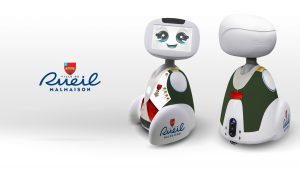
Success Story : Rueil-Malmaison
Smart City Robot: Buddy Supports Citizen Services in Rueil-Malmaison How can artificial intelligence improve the relationship between citizens and public services? The City of Rueil-Malmaison answered this question by deploying…

Success Story : Galerie Lafayette
Success Story Galerie lafayette : Retail Robot Buddy at Galeries Lafayette How can technology make shopping more engaging and memorable? To answer this question, Buddy was deployed as a retail…
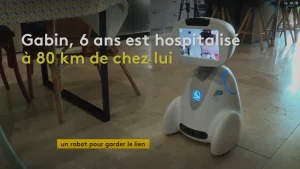
Success Story : Hope-Manon
HOPE MANON: Buddy, a robot for inclusion Children hospitalized for leukemia are placed in a sterile room for a period of 3 to 6 weeks. During this period of strict…